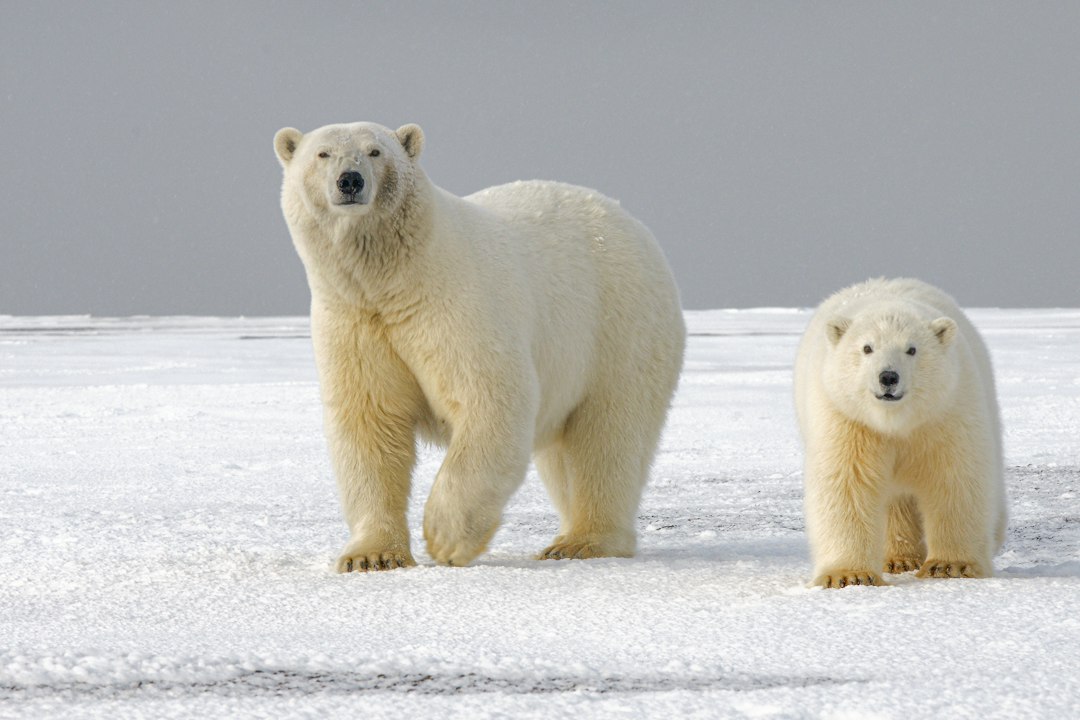
Polar bears and penguins have never encountered each other in their natural habitats.
Polar bears live only in the North Pole (Arctic) and its surrounding terrestrial areas and glacial seas; while penguins live in the Southern Hemisphere (Antarctica, coasts of South Africa, South America, Australia, and New Zealand). Geographically, they are found at the two opposite ends of the planet.
They have only been in the same facility in artificial environments created by humans (zoos or conservation areas).
The misconception that they are found in the same place because both live in cold glacial regions is very common, but they are never close to each other. Polar bears live at the very top of the Earth (North Pole/Arctic), while penguins live at the very bottom (South Pole/Antarctica and its surroundings).
There is an entire planet between them, a distance of approximately 20,000 kilometers. Since one is on the roof of the world and the other on the ground, it is geographically impossible for them to cross the vast oceans, continents, and equatorial heat to reach each other.
Differences Between the Two Poles
Although the North and South poles superficially resemble each other, they have completely opposite structures in terms of geological, geographical, and ecological aspects. The fundamental difference between them is that one is an ocean, and the other is a continent.
1. Land and Sea Structure
North Pole (Arctic): It is an ocean surrounded by land. The ice sheet on it floats on the ocean water.
South Pole (Antarctica): It is a colossal continent (landmass) surrounded by oceans. The ice mass, which is kilometers thick, rests directly on the land.
2. Temperature Difference
The South Pole is much colder. Antarctica is the coldest place on the planet, with an average of -49°C, both because it is a high landmass (average 2,300 meters elevation) and because the landmass beneath it prevents the warming effect of seawater.
The North Pole is milder. It is around -18°C on average because it has deep ocean waters beneath it and is close to sea level. Ocean water acts as a kind of heat regulator.
3. Plant and Animal Life
North Pole (Arctic): Since it is terrestrially connected to the continents of Asia, Europe, and North America, it hosts terrestrial predators and mammals. Polar bears, Arctic foxes, reindeer, and musk oxen live here. In summer, as the frozen soil (permafrost) on land thaws, tundra vegetation consisting of shrubs and lichens is observed.
South Pole (Antarctica): It is completely isolated from other continents by vast and stormy oceans (Southern Ocean). Therefore, there are no native terrestrial mammals, reptiles, or amphibians. The only permanent inhabitants on land are microscopic insects and lichens. Life is entirely on the coasts and in the ocean; penguins, seals, and whales live dependent on the marine ecosystem.
Can a penguin live in the North Pole?
Theoretically, yes, penguins could live and feed in the North Pole (Arctic). In fact, a real attempt was made historically.
The factors enabling and preventing penguins from living in the North Pole are as follows:
Reasons They Could Adapt
- Climate and Food: The air and water temperatures in the Arctic region are milder compared to Antarctica. Northern seas are very rich in fish, crustaceans (krill), and squid, which penguins feed on.
- Historical Ecological Niche: In the North Pole, a flightless bird species called the Great Auk (Pinguinus impennis), which occupied the same ecological role as penguins, used to live. (Actually, the name “penguin” was first given to this bird and later transferred to the birds in the Southern Hemisphere due to their resemblance.) However, Great Auks became extinct in the 19th century due to excessive hunting by humans.
Factors Preventing Their Natural Establishment
- Terrestrial Predators: In Antarctica, there are no terrestrial mammalian predators that hunt penguins on land; therefore, they breed extremely comfortably on land. In the North Pole, however, there are polar bears, Arctic foxes, and wolves. Flightless and slow-moving penguins would become extremely easy prey for these predators.
- Breeding Grounds: Since penguin eggs and chicks would be completely defenseless against terrestrial predators, sustaining the colony population in the long term would be very difficult.
Historical Experiment: Norway’s Penguin Project (1936)
In 1936, Norwegian scientist Carl Schøyen released King Penguins brought from Antarctica to the Lofoten Islands in Northern Norway with the aim of introducing them to the Northern Hemisphere. The penguins adapted to the region and managed to survive for several years. However, due to their small numbers and being hunted by local predators and humans over time, the population in the region completely died out by the late 1940s.
Can a polar bear live in the South?
Theoretically, yes, polar bears could easily live in Antarctica (South Pole) in terms of climate and food. In fact, due to their existing physiological structure, the South Pole could become a “food paradise” for polar bears.
Factors determining the ability of polar bears to live in the south are as follows:
Reasons They Could Adapt
- Climate and Cold Tolerance: Polar bears, adapted to the harsh winter conditions, freezing winds, and glacial seas of the North Pole, could easily cope with the cold in the coastal areas of Antarctica.
- Abundance of Food Sources: The main food of polar bears is seals. The coasts of Antarctica host hundreds of thousands of seals, such as Weddell seals, Crabeater seals, and elephant seals, as well as penguin colonies.
Possible Consequences for the Antarctic Ecosystem
- Predation Pressure and Vulnerable Prey: Seals and penguins in Antarctica have never encountered a terrestrial predator (polar bear, wolf, etc.) in their evolutionary process, so they have no fear of predators on land. While Arctic seals constantly watch out for polar bears when breathing through holes under the ice, Antarctic seals lie on the ice completely defenseless.
- Ecological Devastation: If a polar bear were introduced to Antarctica, it could quickly decimate these defenseless seal and penguin populations without requiring significant hunting skills. This situation would lead to irreversible devastation in the Antarctic ecosystem.
Factor Making Their Life in the South Difficult
- Sea Ice Dynamics: Polar bears depend on sea ice (pack ice) for hunting. The sea ice surrounding Antarctica melts much more extensively in the summer months compared to the North Pole. The periods when bears might starve on land during summer could be longer and more challenging than in the Arctic.
Leave a Reply