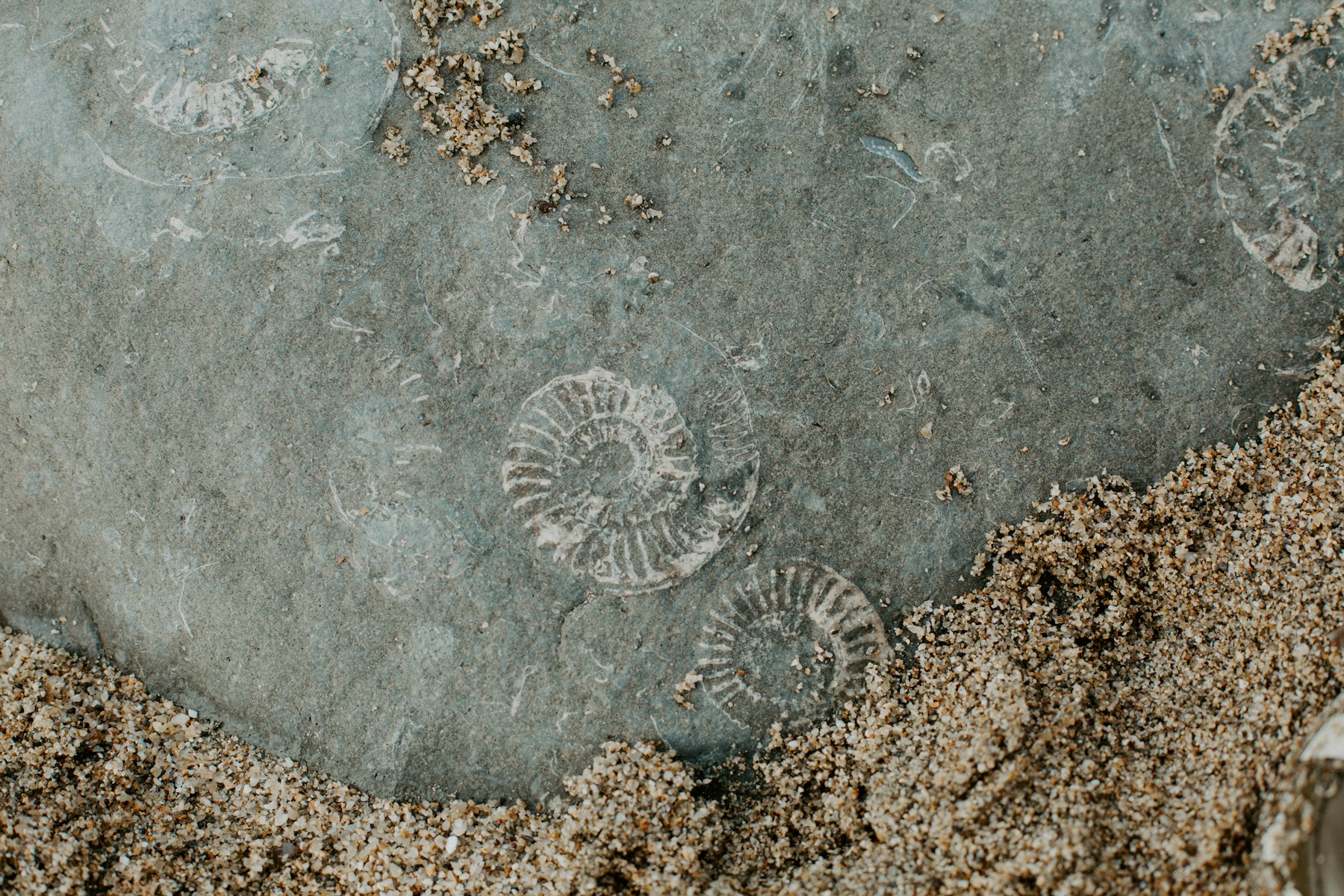
The Ediacaran fauna (or Ediacaran biota) is the oldest known community of complex and macroscopic (visible to the naked eye) multicellular organisms in Earth’s history. They lived in the oceans approximately 635 to 542 million years ago, during the Ediacaran Period, just before the Cambrian Explosion.
Key Characteristics
- Soft-Bodied: They lacked hard structures like bones, shells, or teeth. For this reason, their fossilization occurred very rarely and under special conditions.
- Unusual Anatomies: They did not much resemble modern animals. Most had tube, disc, or fern-leaf-like, quilt-stitch-like (fractal) tissues. They lacked distinct organs like a head, mouth, or digestive system.
- Lifestyle: A large part lived attached to the ocean floor (sessile). They were not predators; they likely obtained their nutrients by filtering or absorbing microscopic matter directly from the water.
- Prominent Examples: Dickinsonia (a flat, oval, segmented organism) and Charnia (a leaf or feather-like form) are among the best-known Ediacaran fossils.
Scientific Disagreements
The place of these organisms in the tree of life is a controversial topic among biologists and paleontologists, and there is no single established truth:
1. One group of scientists argues that these were primitive ancestors of today’s animals (especially jellyfish, corals, or worms).
2. Different views suggest that these fossils might have been gigantic single-celled organisms, underwater fungi, or complex algal colonies.
3. Another widely discussed strong hypothesis (the Vendobionta or Vendozoa hypothesis) is that these organisms constituted a separate biological kingdom, not directly related to any modern living group, and completely unsuccessful in the evolutionary process, leading to their extinction.
Their Extinction
Ediacaran organisms suddenly disappeared from the fossil record at the beginning of the Cambrian Period (approximately 540 million years ago). Although the exact cause of this mass extinction is not fully known; the emergence of the first active predators with teeth and jaws during the Cambrian Explosion may have led to the demise of the defenseless Ediacaran organisms. Additionally, changing ocean chemistry and ecological competition with new mobile species are among the prominent theories.
Dr. Alexander (Alex) Liu and His Discovery
Dr. Alexander (Alex) Liu: Is the paleontologist who discovered animal trace fossils dating back 565 million years ago in the Mistaken Point region of Canada in 2008. This discovery holds immense significance in evolutionary history as these are the oldest known traces left by the first organisms to begin crawling and contracting on the seafloor.
Liu’s distinctive contribution is precisely that he discovered and studied those primitive “pathways” (trace fossils) left by the first organisms that moved by crawling or contracting on the Ediacaran seafloor. The philosophical and evolutionary research into why and how organisms began to move, leave traces, and navigate on Earth directly starts with Liu’s scientific findings. Dr. Alex Liu and his team (in their famous papers published in 2010) interpreted these structures, found in the Mistaken Point rocks in Newfoundland, Canada, as the oldest known trace fossils belonging to animals actively moving by muscle power. This discovery, dated to approximately 565 million years ago, overturned the established understanding of the Ediacaran fauna, which was previously known as “immobile, simple organisms attached to the ocean floor.”
Liu’s Core Interpretations and Evidence
- Evidence of Biological Movement: He argued that these groove and ridge-shaped traces, approximately 5 to 17 centimeters long in the rocks, were not formed by wind, water currents, or a drifting inanimate object. This is because at one end of the traces, there was a disk-like body impression belonging to the organism that moved by cutting through the microbial mat (biofilm) on the ocean floor.
- Presence of a Muscle System: To leave such clear and directional crawling traces, the organism needed to have contractile muscle fibers and a hydrostatic skeleton, however primitive. Liu likened these traces to the very slow displacement of modern sea anemones (anemones) on the seabed by contracting their muscles.
- Pre-Cambrian Movement: This discovery proved that active animal mobility began at least 20-25 million years before the Cambrian Explosion (541 million years ago).
“First” Concept in Paleontology and Debates
Saying “definitely the first” is always difficult in paleontology, and there are nuances and debates among scientists on this matter:
1. Older Claims (Controversial): Some structures proposed to be trace fossils have been reported in rock layers older than Mistaken Point (e.g., Uruguayan finds dated to 585 million years ago). However, there is no scientific consensus on whether these structures truly represent animal movement or are physical traces left by currents or giant single-celled organisms (e.g., giant amoebas similar to Gromia).
2. Significance of Liu’s Find: The vast majority of the scientific community accepts Dr. Liu‘s Mistaken Point findings as the most solid and oldest trace fossils whose geological age has been definitively determined and indisputably proven to have been left by a muscular metazoan (multicellular animal).
Behavioral Theories: Why Did They Move?
In evolutionary biology, the fundamental behavioral theories discussed regarding why early organisms moved to form traces (pathways) in a specific direction are centered on two main axes. The concept of “homing” (nest fidelity / homing) is considered one of the most fundamental reasons for pathway formation:
1. Nest Fidelity / Homing Theory: Some organisms leave their safe refuges (nests or rock crevices where they are attached) to feed, but when they are done, they follow their own physical or chemical (mucus/pheromone) trail to return to their starting point to protect themselves from dangers or to return to a suitable micro-environment. For example, this behavior, seen even in modern organisms like sea snails and praying mantises, is one of the oldest mechanisms for a route to repeatedly form a permanent “pathway“.
2. Food Seeking and Efficiency (Optimal Foraging) Theory: This is the strongest scientific interpretation specifically for the first mobile organisms of the Ediacaran period (like Liu’s findings). The ocean floor was covered with a thick microbial mat (biofilm) rich in nutrients. Sessile organisms starved when they consumed the food at their location. The first organisms capable of muscle-powered movement, however, left directional traces to move away from depleted areas and reach new and fresh microbial mats, and in doing so, to avoid traversing their own previously visited (food-depleted) trails.
Related reading
 ScienceWhy Are Zebras Striped Black and White?
 ScienceThe Incredible Escape Reflexes of Rabbits
 ScienceThe Carcinization Process of Evolution and False Crabs
 ScienceHow Cats Analyze the Wind
 ScienceThe Last Wild Horse: Przewalski’s Horse
 Drinks & foodsThe Use of Perfume Support Alongside Food in the Past
 HistoryHow Was the Color Purple Discovered?
 HistoryWhy Are Cows Sacred in India?
Read more · Science
 The Enigma of Deja Vu
 The creation of the world’s first webcam to monitor coffee
 Do Women Fall in Love? Differences in How Women and Men Fall in Love
 When Crows Get Sick, They Go to Ant Nests
 The Relationship Between Integrals, the Two-Body Problem, and the Three-Body Problem
 Scientific Ethical Rules Need Updating
 Is Fear a Simulation?
 Cannabinoid Receptors, How Do We Perceive THC?
 Methane-Based Life Theory on Titan
 The Effect of Pineapple on Body Odor
 How far can an electric car go on a single charge?
 Are Men More Shy Than Women?
Leave a Reply