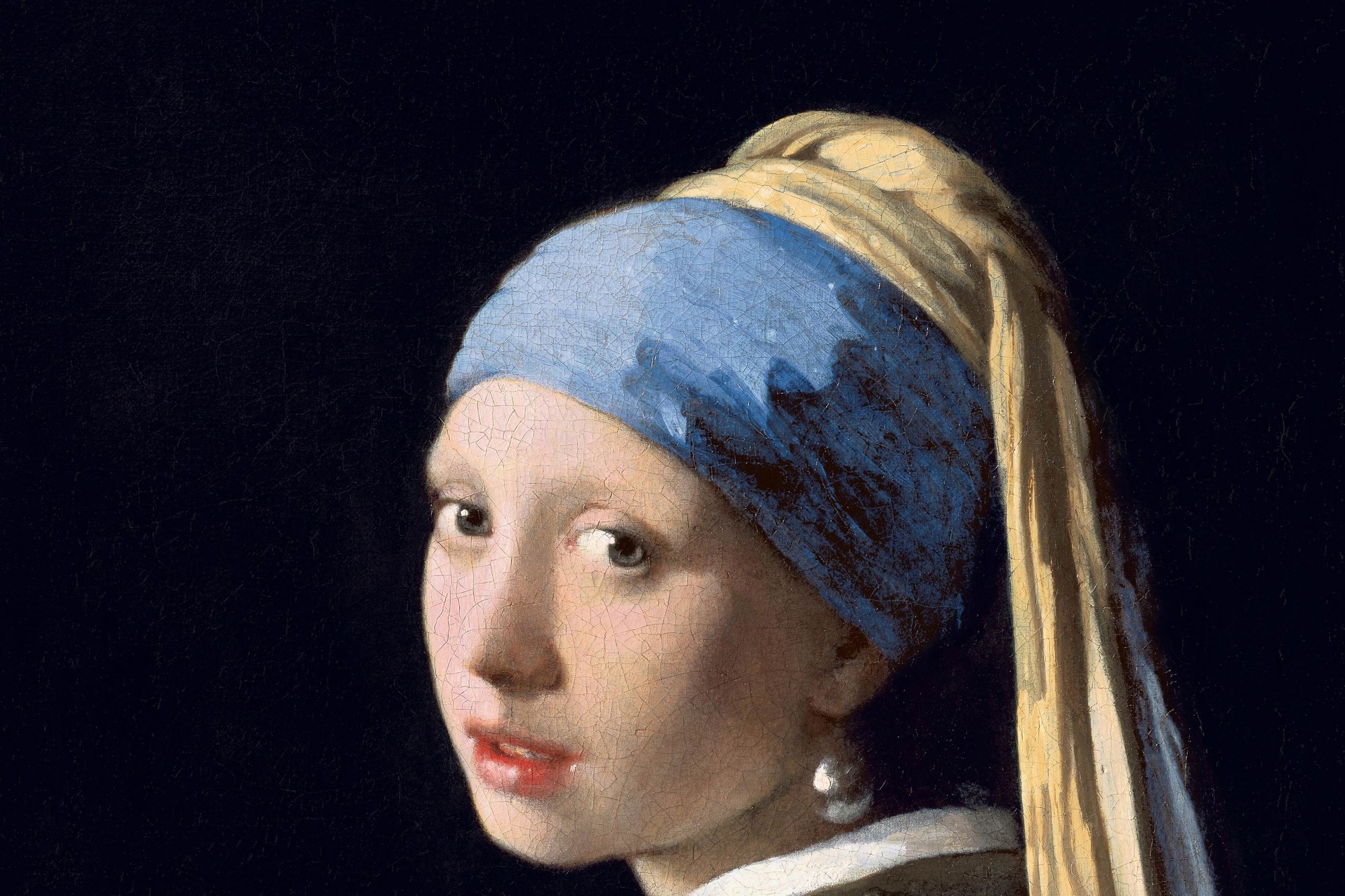
The style Johannes Vermeer employed in his painting “Girl with a Pearl Earring” (İnci Küpeli Kız) is one of the most refined examples of the Baroque period specific to the Dutch Golden Age.
Vermeer’s Technical and Stylistic Approaches in This Work
We can summarize Vermeer’s technical and stylistic approaches in this work with the following headings:
-
The “Tronie” Genre
Technically, this painting is not a portrait but a genre called “tronie” in Dutch art. The purpose of tronies is not to immortalize a specific person; rather, it is to display character characteristics, exotic clothing, or the artist’s technical skill. The turban on the girl’s head was not a daily garment in Holland at that time but an accessory chosen to add an exotic/oriental flair. -
Use of Light and Color (Chiaroscuro)
Vermeer is known for his mastery in using light.- Chiaroscuro: In this technique, influenced by Italian art, he created depth and dramatic focus by using an illuminated figure against a dark background.
- Pearl: When painting the pearl, he did not actually draw a distinct line; instead, he used a few white brushstrokes showing the reflection of light, allowing our brain to perceive it as a “bright pearl.”
-
“Sfumato” Effect
Vermeer used a method similar to the sfumato (smoky/soft transitions) technique also employed by Leonardo da Vinci. The transitions in the girl’s facial features, the corners of her lips, and her eyes are very soft; instead of sharp lines, a natural texture where colors blend into each other prevails. -
Pigment Selection (Ultramarine)
The artist used real Ultramarine blue, derived from the Lapis Lazuli stone, which was more valuable than gold at the time. The vibrant and deep blue of the girl’s turban shows Vermeer’s emphasis on material quality and the luxury of his style. -
Camera Obscura Debate
The “photo-like” realism in Vermeer’s style has led many art historians to believe that he used a Camera Obscura (dark box) device. The distribution of light on objects and the softness in out-of-focus areas bear the traces of these optical aids.
The Term Tronie
The term Tronie is actually an old Flemish word meaning “face” or “countenance.” Let’s clarify why this style is so special and why Vermeer gravitated towards this genre with a few points:
- Model Identity Is Irrelevant: In a normal portrait, the goal is to document the status or identity of that person (e.g., a duke or a wealthy merchant). In a tronie, the identity of the model does not matter. The artist sometimes used a servant from his home, sometimes a family member, and sometimes just a face from his imagination.
- Emotion and Costume Experimentation: Artists often used this genre to “showcase their skill.” The exotic turban, moist lips, and curious glance over the shoulder in “Girl with a Pearl Earring” are entirely intended to evoke an emotion in the viewer and to demonstrate how light appears on different textures (fabric, skin, pearl).
- Market Value: In Holland at that time, such paintings found buyers more easily in the art market compared to heavy, specially commissioned portraits. People enjoyed hanging these unknown yet “impressive” faces in their homes.
Vermeer, in this painting, placed the girl against a pitch-black and deep void, drawing attention entirely to these “tronie” characteristics. If there were a room or objects in the background, this would be a genre painting; but as it is, it is a pure character study.
The Emergence of Tronie
Tronie emerged entirely as a genre specific to Holland and its surrounding regions (Flanders/Belgium).
The emergence and spread of this style occurred as follows:
- Geographic Origin: It blossomed in cities such as Antwerp (Belgium) in the late 16th century and Haarlem and Amsterdam (Holland) in the early 17th century.
- Dutch Golden Age: Tronie experienced its major boom in the 17th century, the period when Holland was experiencing its golden age in art. Holland was a republic at that time, and because there was no pressure from the church or kings, artists began producing for the “free market.”
- Why Holland?: Dutch merchants were looking for interesting and aesthetic works to adorn the walls of their homes, but something less formal than very expensive portraits. Tronie entered the market as a wonderful “decorative art” product that met this need.
The Difference of Tronie from Others
At that time, art in the rest of Europe (Italy, France, Spain) generally progressed in two ways:
- Religious/Mythological Paintings: Massive church and palace decorations.
- Official Portraits: Works documenting the identities and wealth of aristocrats.
Holland, however, shaped world art history by inventing or developing smaller-scale and “artist-focused” genres such as tronie, still life (inanimate objects), and landscape painting.
After Tronie
Tronie was a very critical step in the artist’s liberation process. With tronie, artists began to paint “not a person, but a situation/light,” and the door opened wide. Immediately after tronie, and simultaneously with it, “Genre Painting” and subsequent more modern movements gained momentum in art.
We can follow the process as follows:
-
Genre Painting – The Discovery of Daily Life
While tronie focused only on a “face,” Genre Painting focused on the entire room and the daily hustle and bustle of human life.- What happened?: Artists no longer painted kings; they began to paint a woman pouring milk in the kitchen (like Vermeer’s Milkmaid), brawlers in a tavern, or children studying.
- Connection: Tronie had liberated “facial expression,” while Genre Painting placed “the entire life of the ordinary person” at the center of art.
-
Romanticism and the Exaltation of “Emotion” (18th and 19th Centuries)
The curiosity for “exaggerated expression” and “character study” in tronie later inspired the Romanticism movement.- What happened?: Art began to express not just “what it saw” but “what it felt.” Artists like Géricault, while studying the deep pain and expression on the faces of people in mental hospitals (a kind of modern tronies), focused entirely on emotion.
-
Expressionism (Dışavurumculuk) – The Deformation of the Face
This is the most extreme and modern stage of tronie.- What happened?: If tronie was about “experimenting with facial expression,” Expressionism was about exploding that expression. Think of Edvard Munch’s “The Scream” painting. That painting is not a portrait; it is the most radical form of a tronie in the 20th century: the depiction of a pure emotion (fear/panic) through an anonymous face.
-
Photorealism and the Return of Portrait Art
Today, the tronie tradition lives on, especially among hyper-realistic artists and character designers (CGI/Game world). The details on the face of an anonymous character in a video game are essentially modern tronie studies.
In summary, the chain progressed as follows:
- Portrait: “Get to know this important person.”
- Tronie: “Look at this interesting face and light.”
- Genre Painting: “Look at the life of this ordinary person.”
- Modern Art: “Look at the emotion this face makes me feel.”
Johannes Vermeer, Girl with a Pearl Earring (c. 1665), Mauritshuis, The Hague. Public domain, via Wikimedia Commons (detail)
Related reading
 Culture & ArtCanvas Brands Used by Van Gogh
 Culture & ArtThe Man Who Got into Trouble Because of Tango; Astor Piazzolla
 HistoryMarco Polo: Venetian Explorer and Traveler
 Culture & ArtWhere is the Original David Statue?
 Culture & ArtIncorrectly Drawn Horses in Art History
 Culture & ArtThe Grand Egyptian Museum: The World’s Largest Archaeological Museum Dedicated to a Single Civilization
 HistoryThe Periods of Che Guevara’s Memoirs
 Culture & ArtBatman Alley in São Paulo
Read more · Culture & Art
 Scent Chess: A Sensory Experience
 Beyond Craft: Giotto and the Birth of the Artist
 Did Europe Discover Cigarettes Thanks to the Ottomans?
 The Flower That Saved the King’s Life, Meanings of the Lily Flower
 A Short Trip to Spain; Tapas, Siesta, Barcelona
 The Concept and Characteristics of Sprezzatura
 The Unspoken Language of Joy: A Cultural History of Laughter
 The Presence of Private Prisons in the USA
 The Eras Tour & The Swiftie Phenomenon: A Cultural Anatomy of Collective Ecstasy
 The Crossed Fingers Secret: Why Do We Cross Our Fingers for Luck?
 The Ring Finger’s Secret: Why Wedding Bands Adorn the Fourth Digit
 Chess Boxing: Rules and Challenges
Leave a Reply