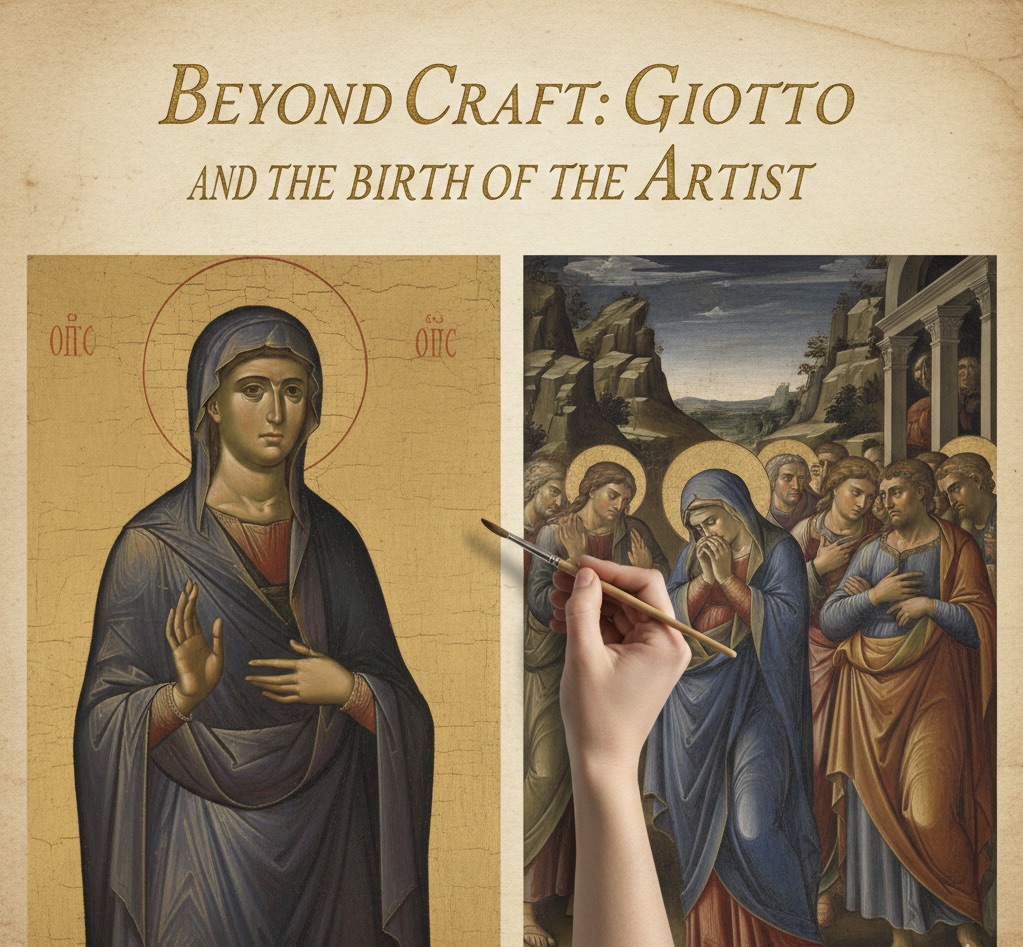
For centuries, painting was seen as no different from cobbling shoes or building a wall. Painters were anonymous craftsmen, fulfilling commissions from the church or nobility within rigid templates (the Byzantine style). Then, someone stepped onto the stage and changed everything: Giotto.
The Transition from Craftsmanship to “Creativity”
Before Giotto, figures were two-dimensional, soulless, and mere symbols. He didn’t just apply paint to a surface; he gave it volume, emotion, and gravity. So, why is Giotto considered the man who transformed craft into art?
• The Discovery of Emotion: Giotto taught his figures how to weep, suffer, and marvel. No longer was the viewer looking at a mere “icon”; they were witnessing a human story.
• The Construction of Space: Instead of flat, gold-leaf backgrounds, he placed his figures in realistic spaces and landscapes with depth.
• The Power of the Signature: The artist was no longer just a laborer following rules, but an intellectual projecting their own perspective onto the canvas (or the fresh plaster).
Why Does It Still Matter Today?
This step taken by Giotto was the spark of “individuality” that opened the doors of the Renaissance. He proved that art is not just a technical skill, but a form of expression. If today we can look at a painting and ask, “What was the artist trying to convey?”, we owe it to Giotto, who picked up the brush in the 14th century and dared to paint the “human.”
Leave a Reply