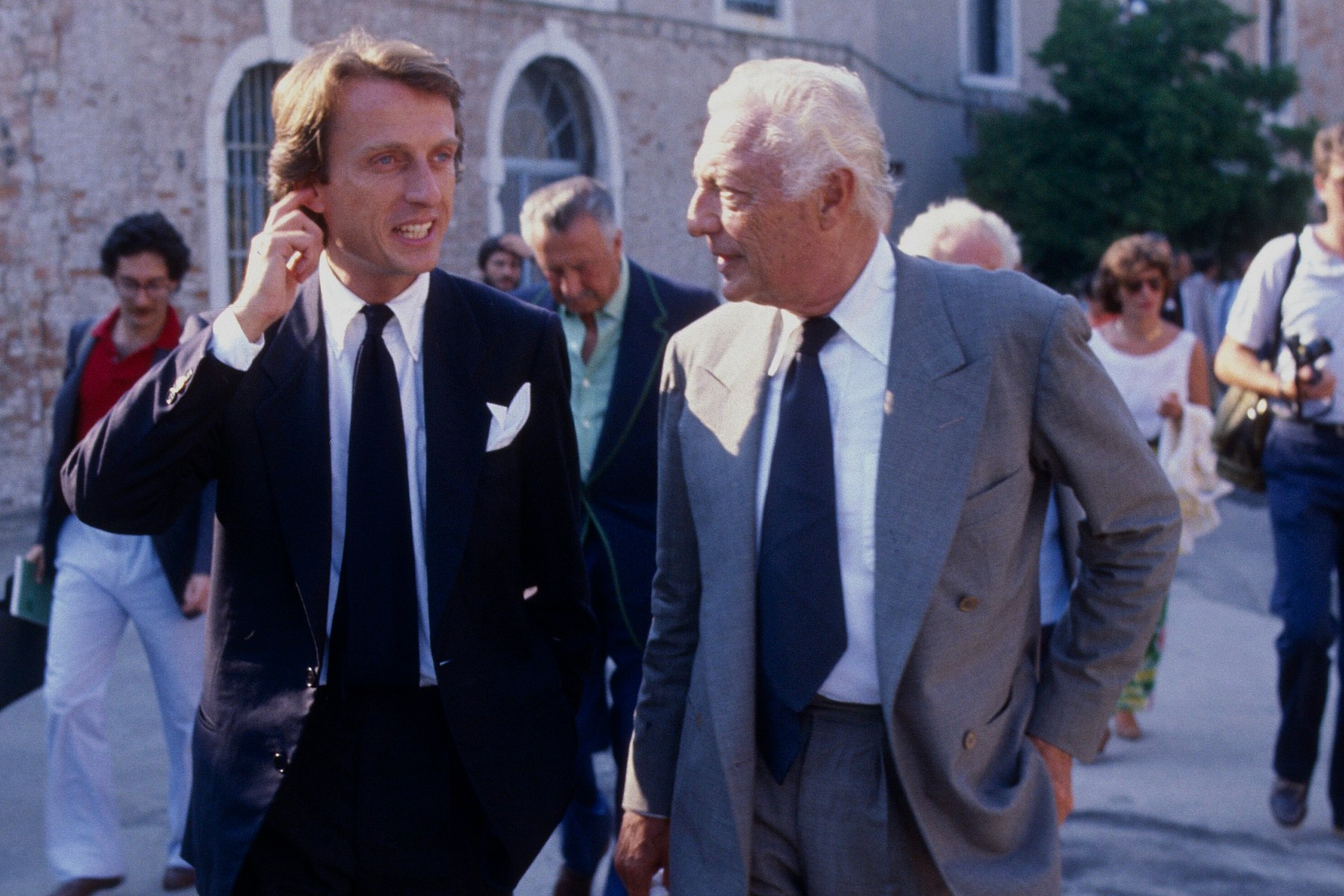
Gianni Agnelli’s practice of dressing removed classic men’s tailoring from being a rigid uniform, defining the modern boundaries of sprezzatura in the 20th century. As one of Italy’s most powerful industrialists, his seemingly careless way of wearing impeccably tailored bespoke suits as if they were ordinary daily clothes set the standards for this trend in modern men’s fashion.
Agnelli’s Preferences that Modernized Sprezzatura
Agnelli’s specific preferences that modernized sprezzatura were:
1. Wearing His Watch Over the Cuff: Wearing his wristwatch not directly on his wrist, but over his shirt cuff. This practical solution, initially adopted to prevent shirt cuffs from wearing out or to see the time faster while driving, eventually became a universally imitated signature.
2. Reversed Tie Rules: Deliberately leaving the thin end of his tie, which should be hidden at the back, longer and asymmetrical at the front, intentionally disrupted the overly serious and millimeter-precise structure of the traditional suit.
3. Unbuttoned Collar Buttons: By never buttoning the collar buttons of his button-down shirts, he demonstrated that he knew the rules of dressing very well but was comfortable enough not to be confined by them.
4. Suit and Hiking Boots: After a car accident, due to a discomfort in his leg, wearing bulky suede hiking boots under his formal suits proved how a medical necessity could be transformed into a charismatic style move.
The aesthetic created by Agnelli went beyond expensive and stylish dressing; it marked the modern era as a display of power where the owner dominated objects, rather than objects dominating the owner.
His most well-known signature move was wearing his watch over his shirt cuff. At first glance, this conspicuous “mistake” became a symbol of how nonchalantly charismatic he was in breaking tailoring rules.
The trend started by Agnelli is now at the heart of classic men’s fashion. You can directly observe the contemporary reflections of this style at events like Pitti Uomo held in Florence; Today’s sprezzatura representatives, inheriting Agnelli’s legacy, continue this illusion of effortlessness with asymmetrical tie knots, handkerchiefs deliberately left carelessly in pockets, and pieces that, despite fitting perfectly, allow for extremely comfortable movement within them.
His Son’s Conversion to Islam
The conversion of Gianni’s son and the natural heir to the Fiat empire, Edoardo Agnelli, to Islam and the subsequent events are as follows:
1. Introduction to Islam: While studying at Princeton University, he focused on philosophy and the history of religions. In 1974, after studying the Quran in New York, he embraced Islam. While initially close to the Sunni tradition, he was influenced by the Iranian Islamic Revolution in the 1980s, traveled to Iran, converted to the Shia faith, and took the name “Mehdi“.
2. Family Rift: His disinterest in capitalism, the industrial business world, and the management of the family company Fiat, along with his preference for a mystical life, severed his relationship with his father, Gianni Agnelli. Gianni Agnelli decided not to leave the management of Fiat to Edoardo. As heir, he first chose his nephew Giovanni Alberto, and upon his early death, his grandson John Elkann (the current chairman).
3. Disagreement and Controversial Death: Edoardo Agnelli was found dead on November 15, 2000, under the Franco Romano viaduct in Turin.
* Official Result: Italian prosecutors and police reports officially recorded the event as a definitive “suicide“.
* Alternative Claims: Especially in Iranian media and among various conspiracy theorists, it is argued that the incident was a staged political murder to prevent a Muslim individual from heading one of Europe’s largest industrial giants like Fiat. Although the family’s hasty burial of the body without an autopsy is cited as grounds for these claims, the assassination claim has never been substantiated with legal or concrete evidence.
Edoardo Agnelli largely rejected his family’s enormous wealth and the management of the Fiat empire. While he did not legally fully relinquish all inheritance and become penniless, he explicitly rejected the power, lifestyle, and capitalist system that came with being the heir to a billionaire family.
The fundamental reasons and consequences of this rejection were:
1. Disinterest in the Material World: Edoardo was not interested in industry, business, or capitalism. While studying at Princeton University, he turned to philosophy, religion, and mysticism. He criticized the superficiality of the material world, choosing inner peace and spiritual development.
2. Renunciation of Heirship: Becoming the head of a massive company like Fiat was his natural right. However, due to his opposition to corporate management and a business world driven by profit hunger, he did not want to take on this role.
3. His Father’s Decision: Given Edoardo’s distant and critical attitude towards the company and the business world, his father, Gianni Agnelli, decided that entrusting the future of Fiat to him would be dangerous. Gianni Agnelli transferred control of the holding and the main inheritance first to his nephew Giovanni Alberto, and upon his death, to his grandson John Elkann, instead of Edoardo.
In summary, Edoardo Agnelli, rather than bank accounts; rejected the power, status, and capitalist legacy that came with being an “Agnelli“, dedicating his life to his beliefs and spiritual quest.
Photo: Gorup de Besanez, CC BY-SA 4.0, via Wikimedia Commons (cropped)
Related reading
 HistoryConstantine’s Acceptance of Christianity Through a Dream
 Culture & ArtThe Concept and Characteristics of Sprezzatura
 HistoryHabsburg Jaw
 Culture & ArtTeachers’ Day is Celebrated on Different Dates in Each Country
 HistoryWhy Are Cows Sacred in India?
 Culture & ArtWhy the Girl with a Pearl Earring Painting is Famous; Its Artistic Style, The Emergence of Tronie
 Culture & ArtThe Man Who Got into Trouble Because of Tango; Astor Piazzolla
 Culture & ArtCanvas Brands Used by Van Gogh
Read more · Culture & Art
 The Cultural History of Knots: Threads of Meaning, from Practicality to Symbolism
 What is Nihilism? Understanding the Philosophy of “Nothingness”
 The Ring Finger’s Secret: Why Wedding Bands Adorn the Fourth Digit
 The Unique Character of French Literature
 Mexicans’ Love for Chili Peppers
 Where is the Original David Statue?
 The Ritual of Gift-Giving: More Than Just an Exchange
 The Return of Wired Headphones Fashion; The Wired It Girl Trend
 The Story of the Word Orange, Its Dynasty, and Its Journey to the Colors of the Dutch National Football Team
 The Crossed Fingers Secret: Why Do We Cross Our Fingers for Luck?
 Batman Alley in São Paulo
 Chess Boxing: Rules and Challenges
Leave a Reply