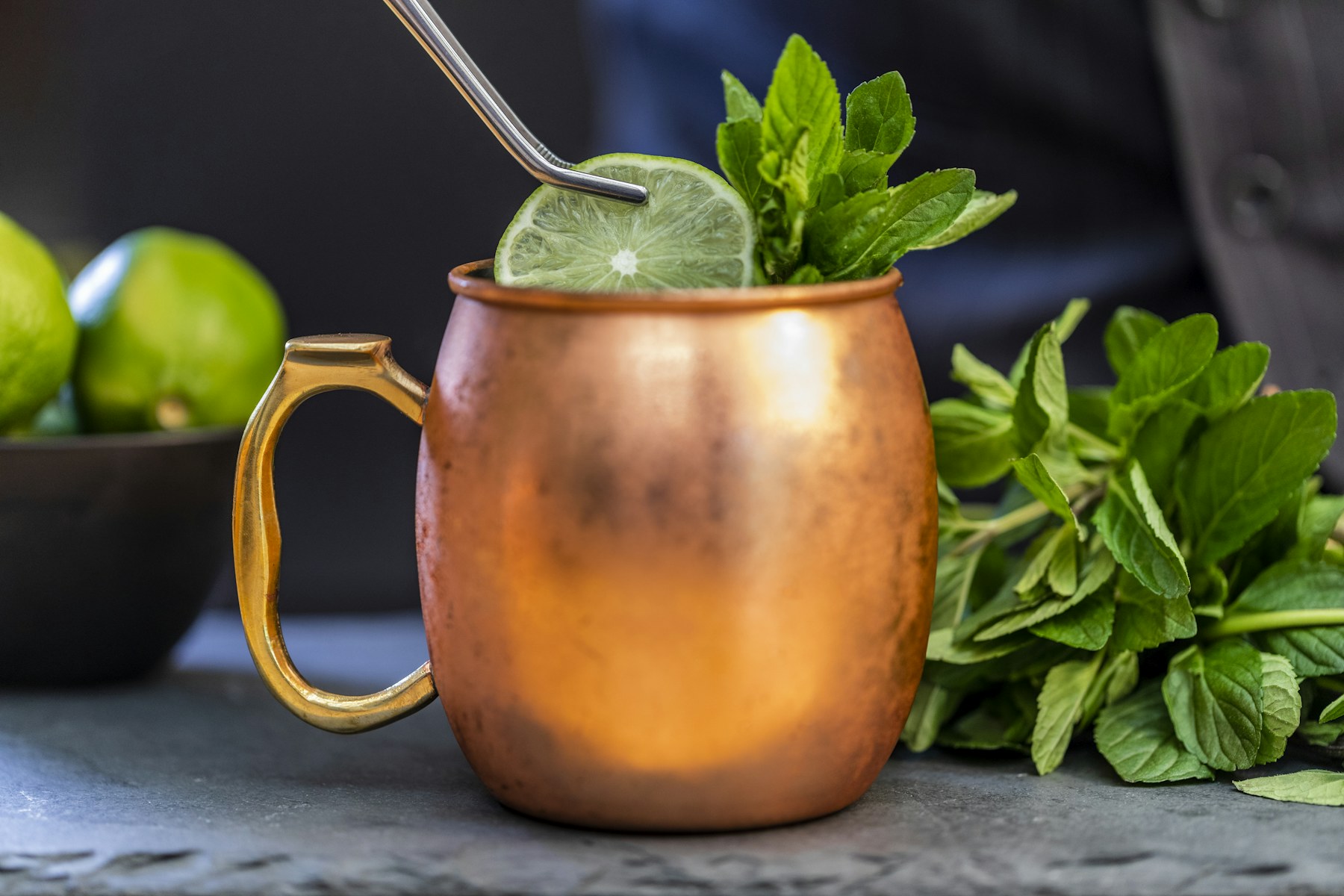
The Moscow Mule is a refreshing and popular cocktail made with vodka, ginger beer, and lime juice. Its most distinctive feature is that it’s served in characteristic copper mugs which keep the drink ice-cold.
Despite its name, it has no connection to Russia; it originated in the USA (Los Angeles) in 1941.
Required Ingredients
- Vodka: 45-60 ml (approximately 1.5 – 2 shot glasses)
- Ginger Beer: 120 ml (Ginger-flavored, alcoholic or non-alcoholic carbonated drink)
- Lime Juice: 10-15 ml (freshly squeezed)
- Ice: Plenty of cubed or crushed ice
- Garnish: Lime slice and optional fresh mint leaves
How to Prepare?
The Moscow Mule is a very practical “build” cocktail (prepared directly in the glass):
1. Chill the Mug: If available, fill your copper mug (or a glass if not) to the brim with ice.
2. Combine: First, add the vodka, then the freshly squeezed lime juice.
3. Top Up: Fill the rest with ginger beer.
4. Serve: Stir gently with a bar spoon to combine the ingredients. Garnish with a lime slice and mint, then serve.
History and Marketing Strategy of the Copper Mug in Moscow Mule
The primary reason for using copper mugs in the Moscow Mule is not a thermal superiority but rather a commercial inventory reduction and marketing strategy from 1941.
At that time, the owners of three different products, which were not yet popular in the US, came together to create this iconic presentation:
- Need for Inventory Reduction: Jack Morgan, owner of the Cock ‘n’ Bull bar in Los Angeles, couldn’t sell his own produced ginger beer. John Martin, who had just acquired the US rights to Smirnoff vodka, was trying to introduce vodka to American consumers (whiskey and gin dominated the US market in those years).
- Inclusion of Copper Mugs: Historical records present two main narratives regarding the identity of this third partner; according to one account, Sophie Berezinski was trying to sell unsellable copper mugs from her father’s leftover copper factory, while another common narrative suggests that Wes Price, a bar supplier with an excess stock of copper mugs, joined the duo.
- Visual Marketing and Polaroid Strategy: John Martin traveled from bar to bar to promote this drink, served with a mule figure engraved on the mugs. He took two photos of bartenders holding the copper mug; he hung one on the bar wall and showed the other to the next bar, creating the perception that “Everyone is drinking this.” The bright and distinctive appearance of copper allowed the drink to be immediately distinguished from other cocktails, even in the black-and-white or early color photographs of that era.
Consequently, the copper mug became a standard as a result of branding, visual differentiation, and the need to convert leftover inventory into cash, rather than the chemistry of the cocktail.
Do Copper Mugs Keep Drinks Cold? Thermal Properties
Copper does not cool the drink on its own; thanks to its high thermal conductivity, it rapidly transfers the heat from the ice and cold liquid inside to the outer surface of the mug, making the drink’s coldness intensely felt on the lips and hands.
Compared to glass, copper’s thermal conductivity coefficient is hundreds of times higher. When ice and a cold drink are placed in the mug, the following physical process occurs:
- Rapid Heat Transfer: Ice and cold liquid absorb heat from the copper walls within seconds. The entire metal rapidly drops to the same temperature as the drink (approximately 0°C-4°C). Glass, being closer to an insulator, only cools its inner surface in contact with the drink, while its outer surface remains at room temperature.
- Condensation and Thermos Effect: On the cooled outer surface of the copper, moisture from the air rapidly condenses, forming a thin layer of water and fogging. This creates a thin boundary layer that slows down heat transfer, contributing to the ice melting slower than expected.
- Sensory Perception of Coldness: When your lips or hand touch the copper, the metal instantly draws heat from your skin. The brain perceives this rapid heat loss as if the drink itself is much colder.
An Important Detail: When copper comes into direct contact with acidic liquids (lime juice, ginger beer, and other low pH drinks), it can react, imparting a metallic taste to the drink and potentially leading to copper poisoning. For this reason, the inner surfaces of cocktail mugs are coated with tin, stainless steel, or nickel; ensuring safe use without compromising heat transfer properties.
Copper Mug vs. Glass Mug: Which is Better for Cold Drinks?
Copper mugs are not a better choice than thick glass or double-walled mugs in terms of pure cooling performance and slower ice melt. On the contrary, if the ambient temperature is high, they can accelerate the warming of the drink. Copper’s superiority lies not in thermal protection, but in the sensory perception of coldness.
The physical differences between the two materials for cold drinking are as follows:
| Feature | Copper Mug | Glass Mug |
| :—————————- | :———————————————————————————————————————————————————————– | :———————————————————————– |
| Initial Contact and Cold Sensation | Very High. The mug becomes ice-cold in seconds; provides an instant shocking cold sensation on lip and hand contact. | Low/Medium. Glass cools slowly, so the outer surface remains at room temperature for a long time. |
| Thermal Insulation (Ice Longevity) | Poor. It transfers ambient heat inward at the same speed. Ice melts faster in hot weather or when held for a long time. | Better. Thick glass slows down heat transfer, delaying the transfer of external heat to the drink. |
| Taste and Odor Neutrality | Depends on Coating. Pure copper with a worn inner coating can react with acidic drinks and leave a metallic taste. | Perfect. Chemically completely inert; does not interfere with the drink’s aroma or taste. |
| Foam and Carbonation | If the inner surface is microscopically rough, it can cause gas bubbles to escape faster. | Smooth glass surface better preserves carbonation and aromatic profile. |
Conclusion
In conclusion, the preference varies according to the purpose of use:
* A copper mug is more enjoyable for rapidly consumed, iced, and high-acid cocktails (like Moscow Mule, Mint Julep) to get the ice-cold tactile sensation of the metal on the lips.
* A thick-bottomed or pre-chilled glass mug is a more functional choice when the goal is for the drink to remain cold longer without dilution (ice melting slower) and to appreciate the pure flavors.
Related reading
 Drinks & foodsAn Examination of Dua Lipa’s Interesting Palate
 Drinks & foodsWhy Does Olive Brine Not Taste Like Olives?
 Drinks & foodsThe Functional Role of Foam in Cocktails
 Drinks & foodsWhat is called “bitter”?
 Drinks & foodsThe Use of Perfume Support Alongside Food in the Past
 HistoryBeer Before Bread Theory
 Drinks & foodsWhen Did Humans Start Choosing Food?
 Drinks & foodsGlycerin; Aroma Carrier
Read more · Drinks & foods
 Did the First Restaurant Chef Rules Emerge from France?
 Have You Ever Tried Olmeca Dark Chocolate?
 Diogenes’s Origin from Sinop
 Application of Roll Technique in Cocktails
 Are Peanuts Eaten with Beer? The Indispensable Part of Pub Culture
 When Did Beer Start Being Drunk Cold?
 Should Cheddar Sauce Be Consumed Hot or Cold?
 From French Cuisine to Mongols; Steak Tartare
 A Cocktail Classic; Porn Star Martini
 George Franz: How Coffee Culture Came to Vienna
 Why Do Chefs Cook Food Over High Heat?
 The Origin of Earl Grey Tea
Leave a Reply