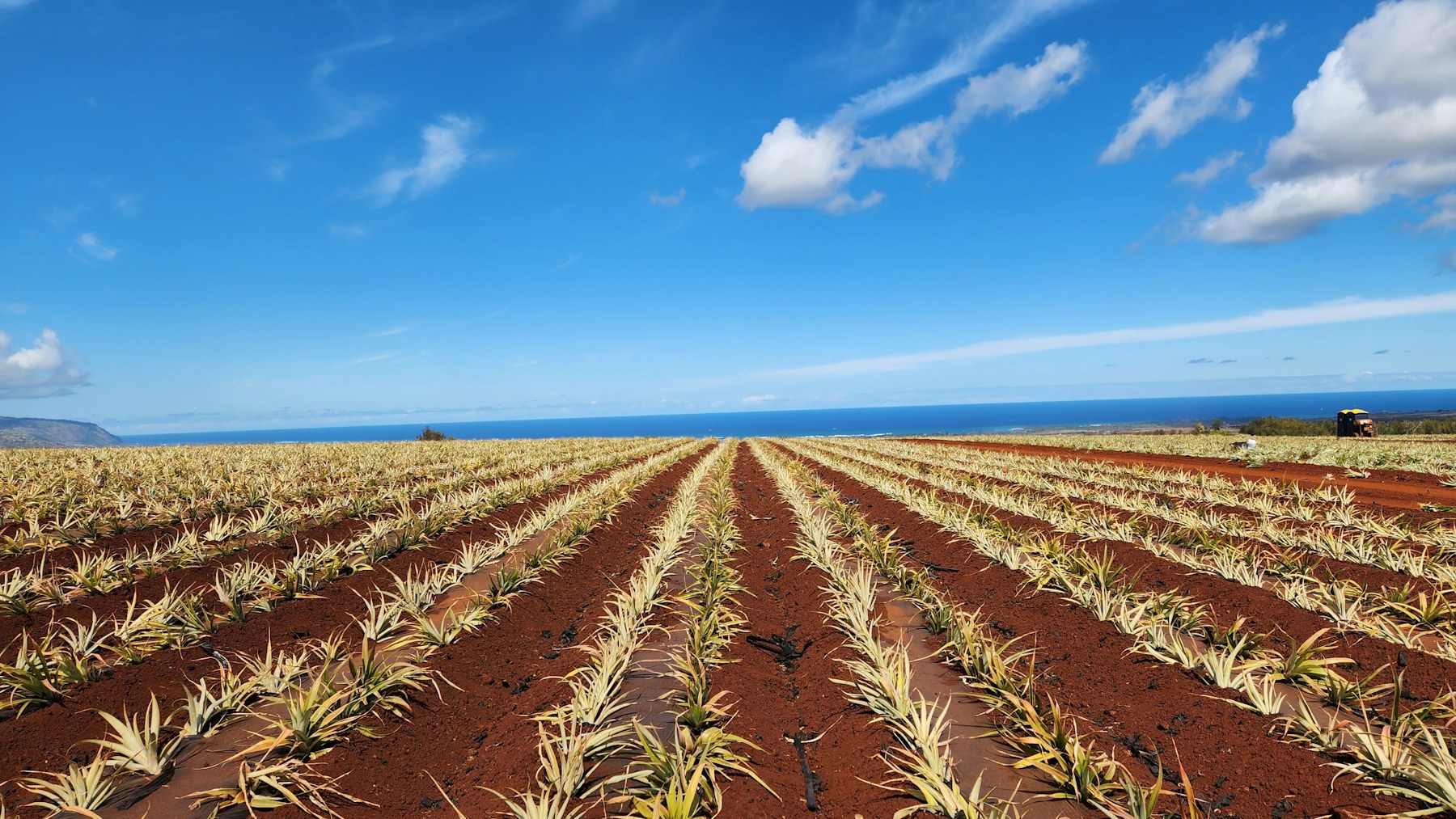
Pineapples grow on a herbaceous plant close to the ground. Each pineapple plant produces only one fruit from its center throughout its life cycle. After the main plant yields its fruit, it does not produce fruit again; production is continued by planting new shoots that the plant gives from its roots or sides.
Commercial Production Methods
The ability to commercially produce pineapples in enormous quantities relies on the plant’s asexual (vegetative) reproduction capability and industrial farming practices. Although each plant produces one fruit, production is continuously propagated through the following methods:
1. Use of Shoots and Crown: While the pineapple plant produces fruit, it also produces new plantlets from its leaf axils (slip), its stem (sucker), and the top part of the fruit (crown). When the fruit is harvested, these plantlets are cut and planted directly into the soil. While production from seed takes years, these plantlets root and reach maturity to bear new fruit in a much shorter period (usually within 12-18 months).
2. Ratooning: After the first fruit is harvested, the main plant’s stem atrophies, but a strong ratoon shoot left in the root system is allowed to grow. With this method, a second harvest is obtained from the same root system without the need to re-till the soil and plant new seedlings.
3. High-Density Planting: Pineapple plants grow vertically and do not occupy much horizontal space. Therefore, they can be planted in fields at very close intervals. In commercial plantations, an average of 50,000 to 70,000 plants are planted per hectare, maximizing the yield per unit area.
4. Flowering Synchronization: In industrial agriculture, ethylene gas or similar plant hormones are applied to the plants to ensure that the entire field flowers and fruits at the same time. This allows for the harvesting and planting of new shoots to be carried out collectively at a factory-like pace.
Maturation Process
The biggest advantage of using shoots or crowns instead of seeds in industrial farming is that it reduces the fruiting period to 12 to 18 months. If a pineapple were grown from seed, it would take over 3 years to produce its first fruit; vegetative (cloning) reproduction dramatically shortens this cycle.
In commercial plantations, this 1 to 1.5-year process works as follows:
1. 0-8 Months (Rooting and Growth): The young shoot planted in the soil roots and increases its leaf mass. The plant reaches maturity to be able to carry and nourish the heavy fruit that will form in its center.
2. Triggering of Flowering: When the plant reaches sufficient biomass, a flower stalk emerges from its center. In industrial production, nature’s pace is not awaited; ethylene gas or plant hormones are applied to the field to ensure all plants flower simultaneously.
3. Fruit Development (Last 5-6 Months): From the appearance of the flowers, it takes approximately half a year for the fruit to form, grow, establish its acid-sugar balance, and reach maturity for harvest.
A pineapple plant produces only a single fruit throughout its entire lifespan, and this process takes 12 to 18 months to complete. After the first fruit is harvested, the stem dies. If a new shoot (ratoon) coming from the root is allowed to grow, it takes an extra 12-14 months for this new shoot to mature and produce its own fruit.
Thus, two fruits are not obtained per year using the same root system; instead, two fruits are obtained consecutively from two different shoots over a total period of approximately 2.5 – 3 years.
Read more · Drinks & foods
 Diogenes’s Origin from Sinop
 When Did Beer Start Being Drunk Cold?
 Are Peanuts Eaten with Beer? The Indispensable Part of Pub Culture
 Should Cheddar Sauce Be Consumed Hot or Cold?
 Did the First Restaurant Chef Rules Emerge from France?
 Why Is the Old Fashioned Glass and Cocktail Called Old Fashioned?
 Why Are There Three Coffee Beans in an Espresso Martini?
 The Functional Role of Foam in Cocktails
 Why Do Chefs Cook Food Over High Heat?
 Kauai Island; Taro, Hawaii, Vodka
 The Place of Couscous in North Africa
 Swedish Meatballs and the Ottomans
Leave a Reply