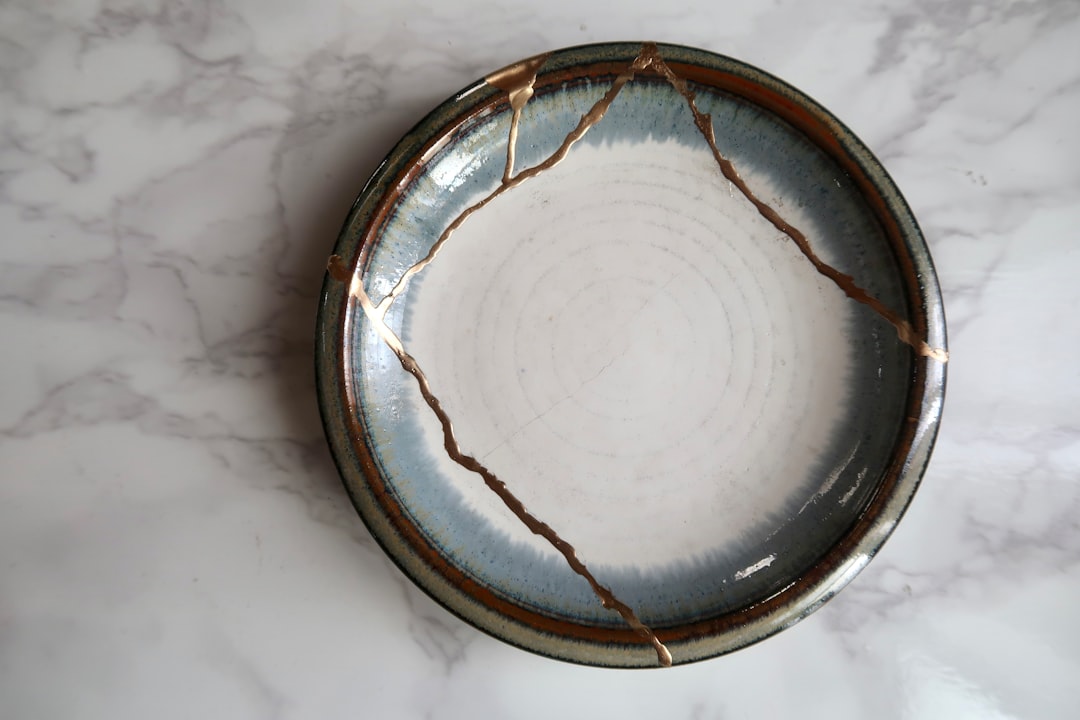
Kintsugi (金継ぎ), often translated as “golden joinery” or “golden repair,” is the traditional Japanese art of repairing broken pottery by mending the areas of breakage with lacquer dusted or mixed with powdered gold, silver, or platinum. Rather than disguising the damage, kintsugi treats the repair as part of the object’s history, highlighting the cracks with precious metals and thereby embracing and celebrating its flaws and imperfections. This philosophy is deeply rooted in Japanese aesthetic principles like wabi-sabi (finding beauty in imperfection) and mushin (acceptance of change), transforming what was once broken into something uniquely beautiful, often more valuable and richer in story than its original form.
At its core, kintsugi is a testament to resilience, a visible declaration that damage does not diminish worth but rather enhances it. It challenges the conventional Western notion of perfection, suggesting that the journey of an object—its breakages and repairs—contributes to its character and narrative. This ancient craft is not merely a repair technique; it is a profound philosophical statement, offering lessons applicable far beyond the realm of ceramics, touching upon themes of healing, acceptance, and the inherent beauty of a lived, imperfect life.
What is the History of Kintsugi? The Origin and Evolution of Golden Repair
The origins of kintsugi are somewhat shrouded in legend, but the most widely accepted story traces it back to the 15th century. According to lore, the Japanese shogun Ashikaga Yoshimasa sent a prized Chinese tea bowl back to China for repair after it broke. When the bowl was returned, it had been mended with unsightly metal staples, a common repair method of the time. Displeased with the crude repair, Yoshimasa challenged his Japanese craftsmen to find a more aesthetically pleasing method. This challenge is said to have sparked the development of kintsugi, where artisans began to use urushi lacquer, a natural resin from the lacquer tree (Toxicodendron vernicifluum), to rejoin the pieces, highlighting the seams with gold dust.
Prior to kintsugi, urushi lacquer had a long history in Japan, dating back thousands of years. It was used in various crafts, from decorative arts to practical items, prized for its durability, waterproof qualities, and beautiful finish. The application of urushi in kintsugi was a natural evolution, combining existing lacquer techniques with a new philosophical approach to repair. The practice became closely associated with chanoyu, the Japanese tea ceremony, where the appreciation for unique, imperfect, and handcrafted ceramics was paramount. Each repaired bowl, with its distinctive golden veins, became a unique piece of art, a narrative of its journey. The aesthetic of kintsugi flourished during the Edo period (1603-1868), becoming a sophisticated art form that celebrated the individuality and history of an object rather than concealing its past trauma.
What are the Philosophical Principles Behind Kintsugi? Wabi-Sabi, Mushin, and Beyond
Kintsugi is more than a mere repair technique; it is a physical manifestation of several deeply rooted Japanese philosophical and aesthetic principles. Chief among these is wabi-sabi (侘寂), an aesthetic centered on the acceptance of transience and imperfection. Wabi-sabi finds beauty in things that are imperfect, impermanent, and incomplete—the natural cycle of growth and decay, the asymmetry of nature, the subtle patina of age. A kintsugi-repaired item, with its visible golden scars, perfectly embodies wabi-sabi by celebrating the object’s history, its flaws, and its journey through time, rather than striving for an impossible, pristine perfection. The golden lines do not hide the breaks; they draw attention to them, transforming them into features of beauty.
Another core principle is mushin (無心), often translated as “no mind” or “mind without thought.” In the context of kintsugi, mushin refers to the acceptance of change, fate, and the vicissitudes of life. It implies moving beyond attachment to the original, flawless state of an object and embracing its new form. When an object breaks, mushin encourages one to accept the event without distress, to see the breakage as an opportunity for transformation and renewed value. This acceptance is crucial for the kintsugi artisan, who approaches the repair with a detached yet reverent attitude, allowing the object’s new narrative to unfold naturally. Kintsugi thus becomes a powerful metaphor for human resilience, suggesting that the experiences that break us can also make us stronger, more unique, and ultimately more beautiful. The visible repairs serve as a reminder that scars tell a story of survival and transformation, a celebration of life’s inevitable breaks and subsequent healing.
How is Kintsugi Performed? The Intricate Process of Golden Repair
The practice of kintsugi is a slow, meticulous, and labor-intensive art form that demands patience, precision, and a deep understanding of materials. The primary material used is urushi lacquer, a natural, highly durable, and food-safe resin, once cured, derived from the sap of the lacquer tree. However, it is a potent allergen when wet, requiring careful handling.
The process typically begins with preparation and adhesion. Broken pieces are meticulously cleaned. Then, raw urushi (ki-urushi) or a mixed urushi (mugi-urushi, made by mixing raw urushi with flour and water for better adhesion) is carefully applied to the broken edges to rejoin the fragments. The pieces are then bound together and placed in a furo (drying box), a humidity-controlled environment essential for urushi to cure properly. This curing process can take several weeks or even months, as urushi polymerizes through a chemical reaction with humidity, not by drying in air.
Once the urushi has cured and the pieces are securely bonded, the gap-filling and shaping stage begins. Any missing fragments or large gaps are filled using sabi-urushi (a paste made from urushi and fine clay powder) or kokuso-urushi (a mixture of urushi, sawdust, and other fibers for larger voids). These fillers are applied in thin layers, each requiring its own curing period in the furo, followed by careful sanding and polishing to achieve a smooth surface that aligns with the original form of the pottery. This meticulous layering and curing process can be repeated multiple times to ensure structural integrity and aesthetic refinement. Finally, the surface is prepared for the precious metal application, often involving a final layer of black or red urushi as a base. The artisan then carefully dusts the wet lacquer lines with finely powdered gold, silver, or platinum using a soft brush, a process known as maki-e. After another curing period, the object is gently burnished to reveal the lustrous golden seams, transforming the once-broken object into a testament of enduring beauty and resilience. The entire process, from initial break to finished repair, can take anywhere from a few weeks to several months, embodying the meditative aspect of the craft.
What are the Different Styles and Techniques of Kintsugi? Crack, Piece, and Joint Call
While the overarching philosophy of kintsugi remains consistent, the craft encompasses several distinct styles and techniques, each offering a unique aesthetic expression of repair. These variations depend on the nature of the breakage and the artistic intention of the craftsman, allowing for a diverse range of visual outcomes while still adhering to the core principle of celebrating imperfections.
One of the most common techniques is Crack (ひび – hibi). This style involves simply filling the existing cracks with gold lacquer, highlighting the fracture lines with elegant golden veins. It is the most direct application of kintsugi’s philosophy, emphasizing the object’s original form while drawing attention to its new, enriched history. The delicate golden filigree traces the exact path of the damage, creating a unique pattern that tells the story of the object’s trauma and healing.
The Piece Method (欠けの金継ぎ – kake no kintsugi) is used when a piece of the pottery is completely missing. Instead of finding a matching fragment, the missing section is rebuilt entirely with gold or silver lacquer. This method often results in a solid, shimmering patch that stands in stark contrast to the original material, creating a bold statement of repair. It is a more assertive form of kintsugi, where the new material not only highlights the break but also becomes an integral, vibrant part of the object’s new identity, sometimes reshaping its silhouette slightly.
Finally, the Joint-Call or Patchwork Method (呼び継ぎ – yobitsugi) is perhaps the most creative and visually dramatic. This technique involves replacing a missing piece with a non-matching fragment from an entirely different, unrelated piece of pottery. The seams where the disparate pieces meet are then mended with gold lacquer. This creates a deliberate juxtaposition of materials, patterns, and colors, resulting in a “patchwork” effect. Yobitsugi celebrates the idea of repurposing and finding new harmony in unexpected combinations, producing an object that is not only repaired but also fundamentally transformed into something entirely novel. The process showcases a profound understanding of artistic evolution, much like how artists such as Radiohead and Aphex Twin evolve their musical forms by creating unexpected connections and pushing boundaries. Each of these styles, while distinct in their application, uniformly upholds kintsugi’s core tenet: that an object’s history, including its breaks, contributes to its unique and enhanced beauty.
How Has Kintsugi Influenced Modern Culture and Art? Contemporary Interpretations and Symbolism
In recent decades, kintsugi has transcended its traditional craft origins to become a powerful metaphor and a source of inspiration across various fields, from contemporary art and design to psychology and self-help. Its enduring appeal lies in its universal message: that damage and imperfection are not merely to be tolerated but can be sources of strength, beauty, and renewal. This philosophy resonates deeply in a world often obsessed with flawless appearances and the erasure of past mistakes.
In contemporary art and design, kintsugi has inspired a movement towards “visible mending” and the celebration of material histories. Designers create furniture, jewelry, and even textiles that deliberately expose or highlight their construction or repair, echoing kintsugi’s principle of transparency. Artists incorporate cracked elements or golden seams into their works to explore themes of resilience, trauma, and transformation. This influence extends to product design, where brands might intentionally produce items with slight variations or “flaws” that are celebrated rather than hidden, or offer repair services that mimic the kintsugi aesthetic, giving products a second life with added character.
Beyond aesthetics, kintsugi has found a profound symbolic role in psychology and personal development. Therapists and life coaches often use kintsugi as a metaphor for healing from trauma, grief, or personal setbacks. The idea that one’s “breaks” and subsequent “repairs”—the challenges and the journey of recovery—can make an individual more resilient, unique, and beautiful, is a powerful tool for fostering self-acceptance and post-traumatic growth. It encourages individuals to view their scars, both physical and emotional, not as signs of weakness or something to be ashamed of, but as badges of strength that tell a story of survival and inner richness. This perspective challenges the societal pressure to appear perfect, promoting a more authentic and compassionate understanding of the human experience. Kintsugi reminds us that life’s inevitable cracks, when mended with care and acceptance, can lead to a deeper appreciation for our own intricate and valuable narratives, much like the intricate details in Amy Eskridge’s exotic projects, which also carry unique stories and depth.
Frequently Asked Questions
Is Kintsugi safe for food and drink use after repair?
Yes, traditional kintsugi uses urushi lacquer, which is derived from the sap of the lacquer tree. Once fully cured, urushi is incredibly durable, waterproof, and food-safe, making kintsugi-repaired items suitable for culinary use. However, modern kintsugi kits often use synthetic epoxies or glues, which may not be food-safe, so it’s crucial to verify the materials used for contemporary repairs.
Can kintsugi be done at home by an amateur?
While the traditional kintsugi process is complex and requires specialized knowledge of urushi lacquer and its curing conditions, simplified DIY kintsugi kits using non-toxic synthetic resins are available for hobbyists. These kits allow amateurs to experience the aesthetic of golden repair, though they may not replicate the exact durability or philosophical depth of authentic urushi-based kintsugi.
What is the main difference between kintsugi and regular pottery repair?
The fundamental difference lies in their philosophy: regular pottery repair aims to disguise or conceal the damage, striving to return the object to its original, flawless appearance. Kintsugi, conversely, embraces and highlights the breakage with precious metals, treating the repair as an integral and beautiful part of the object’s unique history and adding to its aesthetic value, rather than detracting from it.