The governance and legal system of the Maldives have a complex structure; it wouldn’t be entirely accurate to say it is “governed by Sharia” in a single sentence, but the influence of Sharia on the system is significant.
We can summarize the situation under these headings:
1. Constitutional Structure
The Maldives is a state governed as a presidential republic. According to its constitution, the official religion of the state is Islam, and being a Muslim is a requirement for citizenship. The constitution explicitly states that no law can be contrary to Islamic principles.
2. Legal System (Hybrid Structure)
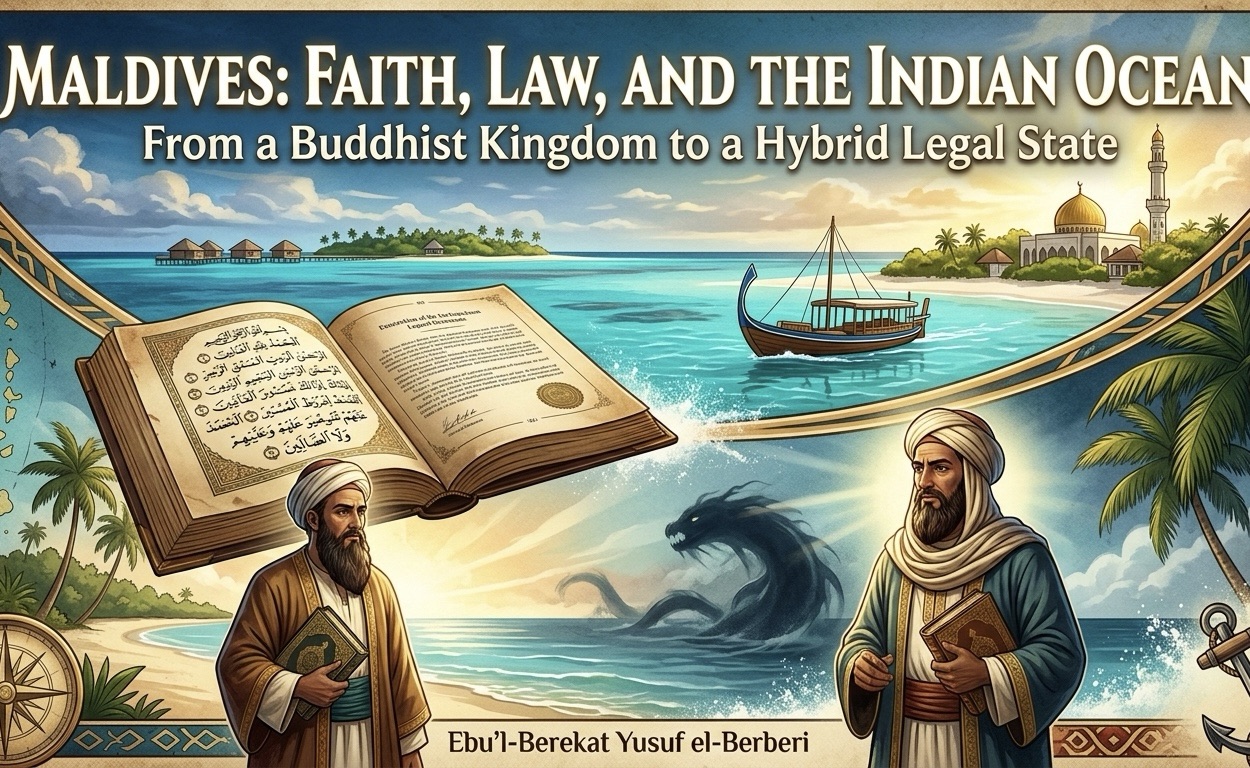
The legal system in the Maldives is a mixture of Islamic Law (Sharia) and English Common Law.
• Civil and Criminal Law: Largely based on modern statutes and the English legal tradition.
• Family and Inheritance Law: Sharia provisions are directly applied in matters such as marriage, divorce, and inheritance.
• Judiciary: When rendering decisions, courts use Sharia as a primary reference if there is a gap in written legislation.
3. Differences in Practice
• Tourism Zones: Rules are quite flexible in the resort islands, which are the lifeblood of the country’s economy. Tourists’ alcohol consumption and attire are generally not interfered with.
• Local Islands: Rules are stricter in the capital, Male, and on inhabited local islands. The sale of alcohol is prohibited, pork is unavailable, and a more conservative lifestyle prevails.
Important Note: While some Sharia-based punishments, such as flogging, legally exist on paper (especially for crimes like adultery), the implementation of these punishments is extremely rare or deferred due to international pressure and modern legal regulations.
How Did Sharia Come to the Maldives?
The introduction of Islam and Sharia (Islamic law) to the Maldives was not an overnight event; it was based on centuries of trade relations and a legendary story of transformation.
Here are the milestones of this process:
1. Transition from Buddhism to Islam (1153)
Before Islam, the Maldives was a Buddhist kingdom for nearly a thousand years. Islam arrived in the 12th century via Arab and North African traders passing through the region.
• Key Figure: The Maghrebi (Moroccan) traveler and scholar Abu al-Barakat Yusuf al-Barbari.
• The Legend: According to local belief, a sea monster (“Ranna Maari”) emerged from the ocean every month and demanded the sacrifice of a young girl. Abu al-Barakat took the place of the sacrifice and drove the monster away by reciting the Quran throughout the night. Upon this miracle, the king of the time, Dhovemi (taking the name Sultan Muhammad al-Adil), converted to Islam.
• The Reality: Historians largely attribute this conversion to the increasing economic power of Muslim traders in the Indian Ocean and the kingdom’s desire to join this powerful trade network.
2. The Sultanate Period and the Shaping of Law
With the King’s conversion, the country became a Sultanate.
• During this period, the justice system began to be administered by qadis (Islamic judges).
• The famous traveler Ibn Battuta served as the “chief qadi” in the Maldives for nearly a year in the 1340s and played a personal role in the implementation of Sharia rulings. In his memoirs, Ibn Battuta describes his struggles to align certain local traditions (such as women walking topless) with Islamic rules.
3. Political Transformations and the Modern Constitution
Although the Maldives remained under Portuguese, Dutch, and British influence for centuries, it maintained its religious identity.
• 1965 Independence: After gaining independence from Britain, Islamic identity was declared the cornerstone of the state.
• 2008 Constitution: This is the foundation of the current system. With this constitution, the Maldives made being Muslim a requirement for citizenship and decreed that no law could contradict the fundamental principles of Islam.
Summary
Sharia came to the Maldives not by the sword, but through trade and cultural interaction. Initially gaining official status with the conversion of the royalty, the system blended with local traditions over time to evolve into today’s hybrid legal structure (English Law + Sharia).
The tomb of Abu al-Barakat, considered the architect of this historical transformation, is still an important landmark in the capital, Male.
Leave a Reply